Mark Davis wasn’t new to early dayparts when he became CEO of Black Rock Coffee Bar in spring 2023.
His career began at Panera, and he’d spent the past few years overseeing operations at Bagel Brands, the parent company of Einstein Bros. Despite that background in breakfast and coffee-adjacent businesses, he wasn’t much of a coffee drinker and wasn’t familiar with Black Rock when the opportunity arose.
“I was in a great place working for a different company, and I wasn’t looking for something else,” he recalls. “I had a friend who said, ‘Hey, they’ve reached out. They’d love to talk to you. Are you willing?’”
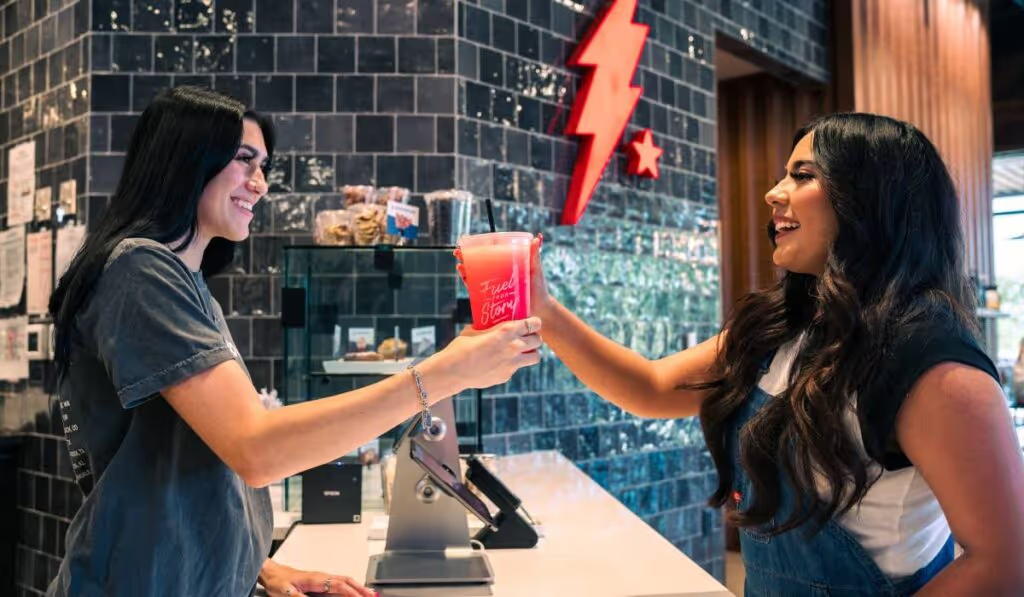
Having never visited a Black Rock, Davis and his wife stopped by the nearest shop. From the moment they walked in, he says, the atmosphere felt different. The greeting was warm, engagement high, and the staff’s energy immediately stood out.
“We walked in and had this unbelievable experience,” he says. “You get this really high engagement, and you quickly come to the conclusion that it’s extremely barista-driven. There’s this genuine connection there that is actually pretty rare.”
He learned the store had “extremely high” employee retention, evident in how staff interacted with guests. When the barista found out they were first-timers and not big coffee drinkers, they walked them through the menu, explaining flavors and beverage styles and asking about their preferences.
For Davis, the message was clear: the barista wasn’t just guiding a purchase, but signaling, “Here’s what I’m going to do to make sure you want to come back.” That mindset was the differentiator.
“I’d never seen anything like it,” says Davis, who has since become a coffee convert (an iced Americano is now his go-to order). “I love the fact that it’s high-end, quality coffee, but then you have this experience that goes with it. I was really drawn to the fact that it was a people-first culture. That’s ultimately what sold me on it.”
The Flywheel Effect
Black Rock began in 2008 as a 160-square-foot drive-thru stand in Beaverton, Oregon, founded by Daniel Brand and Jeff Hernandez. Early stores were intentionally small, built for speed and personal interaction at the window.
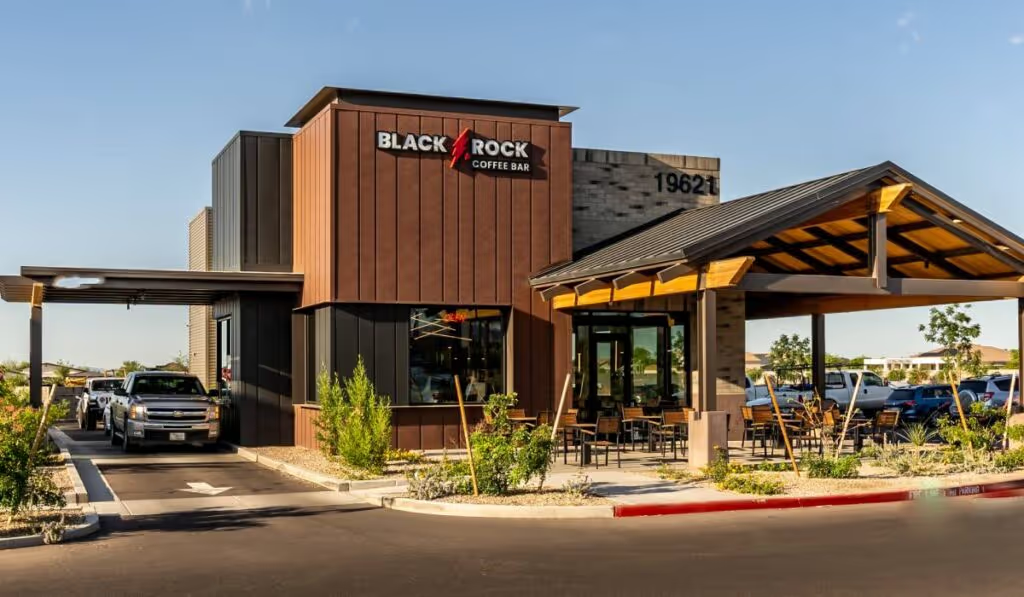
The brand shifted to a more traditional coffee shop model as it expanded over the years, adding lobby spaces while still retaining drive-thrus. By the time the company filed for its IPO last fall, roughly three-quarters of its 158 stores included indoor seating.
Key milestones along the way included West Coast expansion into Washington and California, the decision to franchise in 2013 (along with the first lobbies), entry into Arizona and Idaho in 2016, and Texas and Colorado in 2019. In 2021, Black Rock bought back all franchised locations and returned to a company-owned system.
When Davis came on board two years later, the company had just surpassed the 100-unit threshold with plans to add around 20 shops that year. But it still had some growing up to do.
“It was extremely good at retention and guest satisfaction—higher than anywhere I’d ever seen in my career—but it lacked a bit on the processes and systems,” he says. “If you went back in time, you’d hear me say, ‘We’ve got great people, great culture, great product, and a super strong brand. It just needs to be professionalized.’”
Black Rock has come a long way in recent years on that front, thanks in large part to a renewed focus on career paths and profit-sharing to create clearer trajectories and stronger alignment systemwide.
At the core of those efforts is the brand’s people-first flywheel, a model that CFO Rodd Booth says is rooted in store-level business acumen.
Employees are trained and given tools to manage and grow stores through defined metrics, with a clear path of advancement from barista to shift lead, assistant store lead, store lead, and multi-store lead. Above the store, high performers can move into roles such as area manager and director of operations. Team members are eligible for profit sharing from the assistant store lead level onward, connecting personal growth with company success.
The flywheel includes a balanced scorecard evaluating each store on sales, profitability, team support, and consistent guest experience. Top performers are recognized through quarterly rankings and invited to quartile meetings, which helps reinforce best practices.
“When you look at the forecasting, budgeting, guidance, measurement of turnover, trends around guest satisfaction, and how you adapt to drive that guest satisfaction within the teams—one of the things that we have implemented is trying to make this a career and not just a job,” Davis says. “There is a career path. There is profit sharing. There is a scorecard. And now because of that, we have this unbelievably great acumen at the store level.”
“They understand that frequency matters,” he adds. “They know that when someone has a great experience, they’re going to come more often. They understand that as they grow their sales and profitability, there’s more opportunity for professional and personal growth. All of that works together.”
Baristas in the Spotlight
Brand positioning and marketing also took a sharper focus at Black Rock in the run up to its IPO. The strategy has evolved under CMO Jessica Wegener-Beyer, who joined in the spring of 2024.
The company lacked a formal brand book when she arrived, so her first priority was refining the brand’s identity. Her team conducted surveys, worked with a consultant, and gathered input from employees, customers, and competitors.
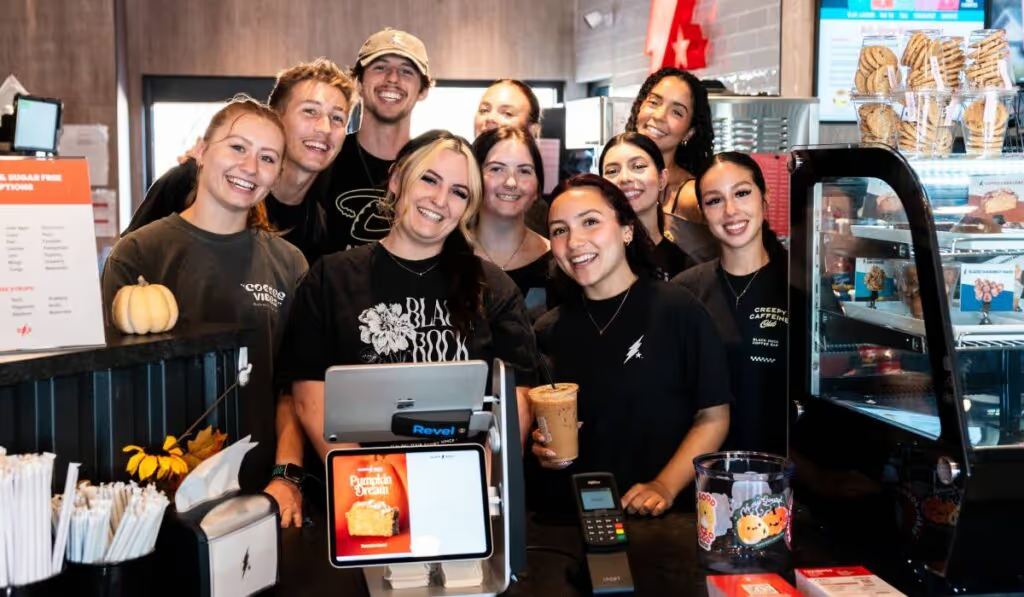
“What came out of that was that we are a barista-first culture,” she says. “They make us or break us and they’re why our guests are coming back. They want to interact with them.”
Those insights shaped marketing, emphasizing barista stories, personal drink recommendations, and everyday “barista hacks.” All employees, including the C-suite, complete five days of hands-on in-store training, highlighting the speed, complexity, and skill required to create meaningful customer interactions.
“It was humbling, but it also gives everyone such a great perspective about how these baristas do not have an easy job,” Wegener-Beyer says. “They’re moving a million miles a second while also forming these relationships that are driving people back. We have to figure out how to show that on the marketing side.”
In the past, “it was a little more promo heavy,” she adds. “Now, it’s really about highlighting them and giving them a space to shine.”
Menu strategy evolved alongside brand positioning. Black Rock remains coffee-forward, prioritizing offerings that complement the coffee rather than masking it. LTO launches now occur six times per year rather than monthly. The brand also focuses more on emotional connections through products, such as last summer’s “Camp Black Rock” s’mores drink, which tapped into nostalgia and seasonal excitement.
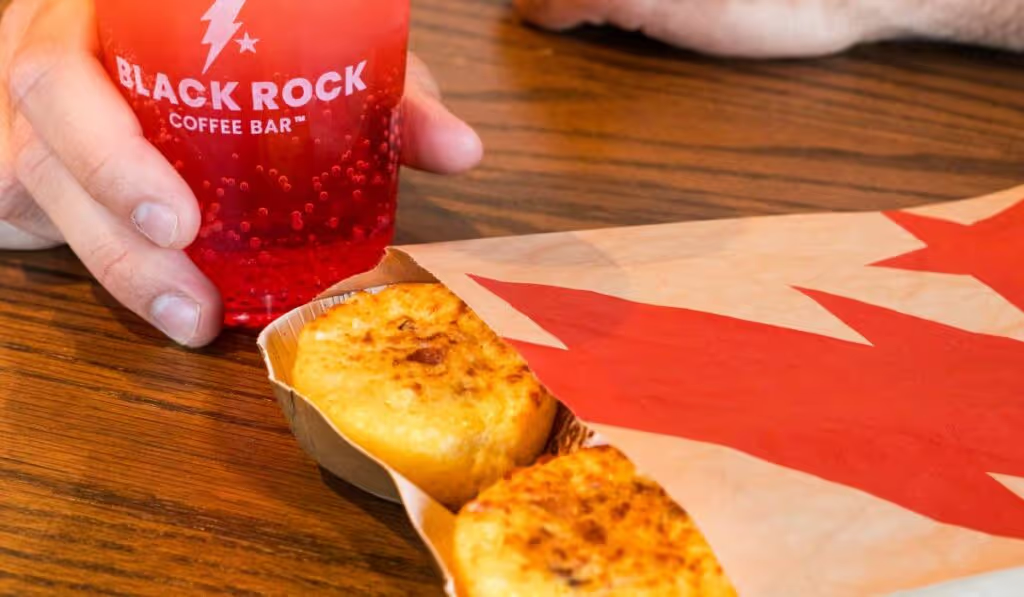
When it comes to food, Black Rock offers breakfast sandwiches, burritos, and pastries alongside regional specialties. In Texas, for example, it has kolaches in San Antonio and Taco Deli breakfast tacos in Austin. A fresh area of focus is new items to fill guest gaps, like savory Egg Bites that launched last year and tap into high-protein afternoon snacking.
Digital and loyalty capabilities have also advanced. The revamped loyalty program launched in summer 2024 enables segmentation by behavior and preference, which is driving more frequency and trial than the previous punch-card system. Nearly two-thirds of transactions are now tied to a loyalty account.
“For a program that’s only a year and a half old, those are numbers I’ll take all day,” Wegener-Beyer says, noting that disciplined operations are the key to growth, with employees asking about loyalty every transaction. “I think it speaks to that connection that our baristas have with our guests.”
The IPO Playbook
As Black Rock matured, the focus shifted to scaling the brand to the next level. Executives cite progress in loyalty and marketing, along with the strength of the beverage category, as key reasons the company was ready to go public.
“The advice I would give anyone is that you’ve got to prepare early, and you’ve got to know what you’re going after,” Booth says. “Once you select banks, once you really dive into the process and say, ‘OK, this is our path’ and you’re on the march towards that IPO, a big part of it is just preparing your team.”
He emphasizes the importance of a strong operations team, deep leadership bench, and home office support to ensure new stores open the right way and the business can scale sustainably. Equally critical is equipping employees with the tools, knowledge, and confidence to bring it all to life every day in the stores.
“Over the last several years, we’ve rolled out a lot of tools to help them operate their business at a high level,” Booth says. “It’s one thing to help them do it, but for us, it’s also about finding ways to reward them.”
He cites profit sharing, introduced three years ago, as a key step that helped drive low turnover. The philosophy is simple: when the team feels supported, they care for guests, which fuels sales and profitability.
That approach has delivered consistent results and set the stage for last year’s IPO. When Black Rock filed, it highlighted 10 straight quarters of positive same-store sales, 96 percent customer satisfaction, and strong visit frequency, with half of customers stopping by five times a month and a quarter coming more than 10 times.
The Road Ahead
Black Rock went public in mid-September, raising $294.1 million and reaching a market value of roughly $1.32 billion. The IPO made it the first coffee brand to debut since 2021, joining Dutch Bros and Starbucks in a competitive beverage segment. Black Rock enters the public arena as a challenger brand: aided brand awareness sits at 47 percent, compared with roughly 83 percent for Dutch Bros and near-total awareness for Starbucks.
Going forward, marketing investments will expand paid media, focusing on regionally targeted campaigns to complement organic and in-store engagement. And after launching its first influencer campaign with TikTok creator Avery Woods last year, the company plans to deepen that partnership and expand into more influencer collaborations.
“Everything will always ladder up to who we are as a brand and what our foundation is, but we’re also going to make sure that we’re always putting creative and content out that resonates with people in specific areas,” Wegener-Beyer says. “It’s about focusing on what our personas are in each market that we’re in, not just doing a shotgun approach.”
Black Rock plans to keep pushing forward with its food offerings, too. Davis says early results from the Egg Bites have been especially encouraging. He expects the item to lift both food mix and daypart mix in the coming quarters and sees meaningful whitespace for further savory innovation ahead. The brand also sees plenty of opportunity to keep driving traffic outside of the morning rush with its proprietary Fuel energy drink line, which mixes at around 23 percent of beverage sales.
Still, Black Rock sees its advantage in staying unmistakably coffee-forward. Its product mix leans more heavily toward coffee than its publicly traded peers, and that’s a distinction it plans to keep emphasizing.
Booth highlights the chain’s high-grade coffee, sourced from eight countries including Brazil, Ethiopia, Colombia, and Mexico. That diversified approach gives Black Rock a broad range of flavor profiles and helps maintain quality even when supply shifts in any single origin. He notes that while certain import tariffs have been applied to beans and equipment, the company’s exposure is limited given how fluid trade policy remains.
“From the way we source our beans to our partnerships across our entire menu, it has really allowed us to remain flexible in what has otherwise been a pretty unpredictable environment,” he says.
Another piece of the quality equation is Black Rock’s roasting operation. It currently runs two roasteries—one in Vancouver, Washington, just over the Oregon border, and another in Tempe, Arizona—each capable of supporting 300 to 400 stores. Executives say the small-batch approach produces a fresher cup with richer, more nuanced flavor.
A third roastery is planned, though the company is still evaluating locations and doesn’t expect it to come online until 2027. That added capacity will be essential as Black Rock works toward its target of 1,000 stores over the next nine years.
The company is entering 2026 with around 175 units across seven states. It hasn’t added a new state in several years and remains intentionally conservative about national expansion.
“Instead of giving this giant TAM for the entire country, we basically said we’d grow at 20 percent each year, and we’d be at 1,000 units by 2035,” Davis says, noting that the current map of seven states alone could support that goal. He expects new states to come gradually, with a couple of new markets likely over the next year or two.
Davis describes the chain’s expansion model as a concentric-circles approach, building dense regional clusters before moving farther out. Growth will radiate from the West first, with the Southeast, Midwest, and East coming into focus later.
Operationally, the brand is zeroing in on its 90-second speed-of-service goal. That relies on experienced teams, a dual-bar setup built for efficiency, AUV capacity above $3 million, and line-busting tactics like tablet-equipped baristas and, in some markets, dual-lane drive-thrus.
Still, the in-store experience remains just as much of a priority.
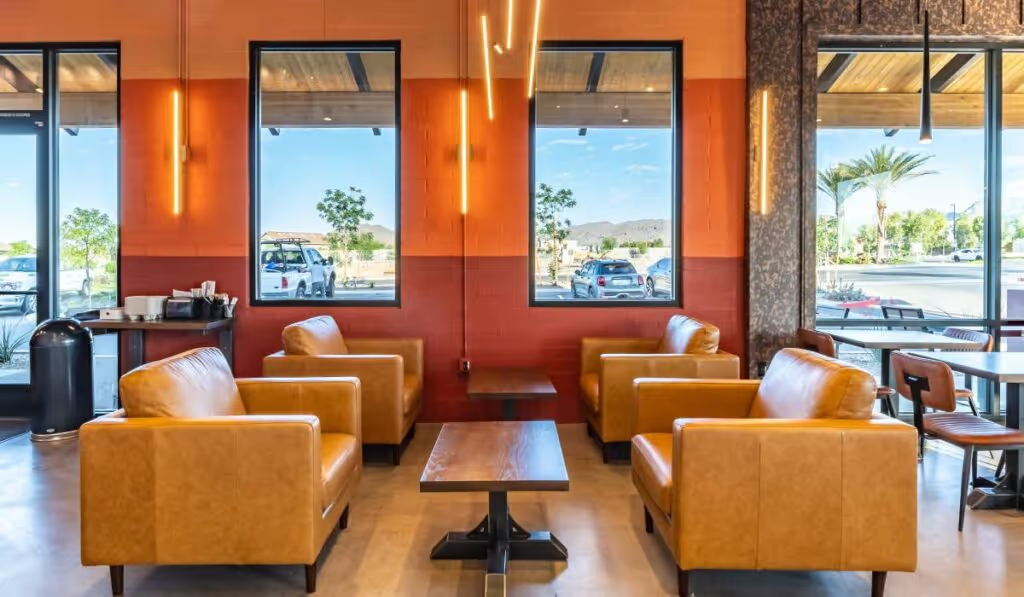
“We have to be fast, and we have to be accurate,” Davis says. “But ultimately, I want you to have the chance to come in and meet these great baristas. With the furniture, the music, and the lighting, the lobby is a really great place to connect.”
Black Rock also recognizes that protecting that experience becomes more challenging as the company grows. One of the main tools for preserving culture is the way it enters new markets. Launches are always led by tenured internal employees who carry the company’s values and set the tone for new teams.
By sending experienced culture-bearers into new regions, the brand ensures new hires are trained directly by people steeped in Black Rock’s ethos. It also creates real advancement opportunities, encouraging long-term employees to relocate and take on leadership roles. To support this approach, the company launched a career-roadmap training program last year, aimed at strengthening its leadership pipeline and helping store leads run their shops more effectively. That program is now scaling across growth markets to build a steady bench of future leaders.
It also recently introduced an inventory-management module designed to improve COGS performance and elevate business acumen across the team. Still early in rollout, the tool has already seen strong engagement, with employees using early lessons to refine the program.
“We realize that no matter how good you want the guest experience to be, it will never be better than the team member experience, so we work really hard and have doubled down on taking care of the team,” Davis says. “We all want to belong. We all want to be part of something. When your voice matters and you get to contribute in a significant way, that’s a point of difference. That’s always going to be our biggest strength.”